Clean Code: Writing Code for Humans

I am a proud monthly subscriber of the online training website Pluralsight. I cannot imagine staying up to date in this field without that subscription. Since my blog focuses on Salesforce concepts, I will tell you that Pluralsight offers several brilliant courses that cover Salesforce.

CleanCodeBut, this post is titled “Clean Code: Writing Code for Humans” by Cory House, a brand new course just offered on Pluralsight. The course is described as the following:

“Anyone can write code a computer can understand, but professional developers write code *humans* can understand. Clean code is a reader-focused development style that produces software that’s easy to write, read and maintain.”

If you are new to programming (of ANY language), then this course if for YOU!

Even if you are an experienced programmer (of ANY language), then this course is for YOU TOO!  I have been doing software programming for over 20 years and have regularly espoused many of the concepts covered in this class, and I learned plenty by watching it. We are ALL prone to writing dirty code and this course has great practical advice for how to avoid this.

If your goal is to remain a programmer (more specifically, a productive and respected programmer), then this course is definitely for YOU!!!!!

Even if you do not already have a subscription to Pluralsight, never fear, they offer a free 10-day trial subscription. So, you really have no excuse. Go and see it I tell you.
Proper Use of ActionStatus component

In preparation for the Advanced Developer exam, I have been painstakingly going page by page through the Visualforce Developers Guide (which can be found online here). Almost every single person that has passed the exam has suggested that you become intimate with this document, but I wonder how many people truly are. I keep finding that the code listed in the tutorials does not work as it should. My last post was about one such error and now I have another big one.

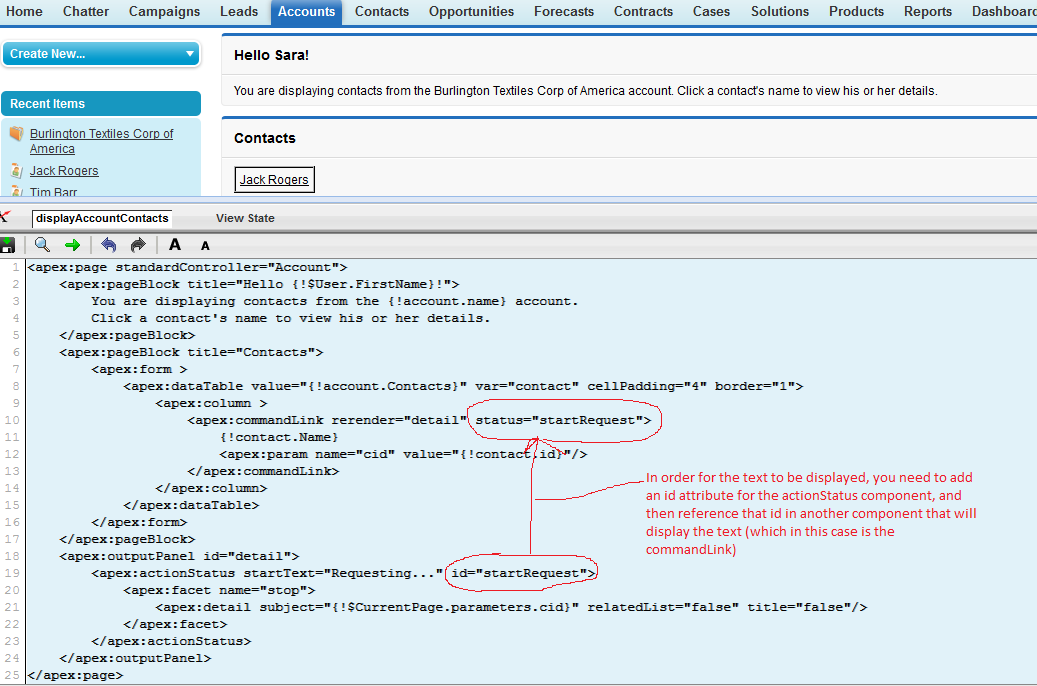
On page 44 of the guide, they provide an example of using the ActionStatus component to provide a status for Ajax operations. Great! It is an awesome tool, but unfortunately, the code example they provide on that page does not work. If you copy the code from this tutorial and use it in a page and then try to see the text, you will not see it.

You can however, make two simple code changes to the code they provide and it will work as promised. But, only if you do this, will it work. So, the code that does work is seen below. What the tutorial authors missed was that an id attribute is needed for the ActionStatus component and that id value must be referenced in the status attribute of another component on the page.

ActionStatusProblemCode

Hope this helps someone else from not being confused about how ActionStatus is supposed to work. At first, I thought I was just not seeing it quickly enough (silly me…)

On Being a Certified Salesforce Developer

sf_cert_dev_rgbAfter six very intense weeks of study, I finally cemented my status as a Certified Salesforce Developer on March 9, 2013. As a former Microsoft MCSD, MCDBA and MVP, let me just say that Salesforce sure ain’t giving these things away. The test was VERY tricky and reminded me of the certification tests for Microsoft SQL Server (those were not easy either).

The funny part is that if you look at the official logo on the left, one might be led to think that the large slash through Software would indicate this stuff is a piece of cake. That is not exactly the case.

While I will admit that Salesforce has removed many of the complexities associated with software development, such as setting up and maintaining development and database servers, it has not totally done away with software (as their logo might suggest). What they have done is expose to small and mid-level businesses the potential of using some very highly functioning and scalable business applications through their affordable and subscription-based cloud-based platform.

As a software developer with twenty-years of experience building enterprise-level business applications for a variety of industries, adding the expertise of cloud-based development using the Force.com platform was a no-brainer. I simply cannot lose with this certification. The demand for highly-trained cloud-based developers is sky rocketing and I intend to strap myself to the top of that rocket.

In the next few weeks, I will continue my education as I prepare for the Salesforce Advanced Developer Certification. This distinction will be even harder to get, as I need to not only pass a grueling test, but I also need to complete a programming assignment and then defend my programming choices in a proctored essay exam. I feel like at the end of this I will have earned a Salesforce PhD.

I am using the excellent Premier Training available from Salesforce to do most of my training. In the coming weeks, I will be posting notes from the online training in hopes that it benefits anyone else out there trying for this certification. There cannot possibly be too many of us. The better trained other developers are in this field, the easier it is for me to work with them. It is also better for me, because they will be producing good solutions that highlight the platforms enormous potential and create opportunities for EVERYONE!

Please share with me your thoughts about cloud-based development and specifically the Force.com platform. I would love to hear from you.